
7 Best Home Gym Equipment Essentials for Beginners (2026)
Home gym equipment does not need to be expensive, complicated, or large. This practical guide shows beginners how to build a versatile setup that supports safe strength training, consistent progress, and easy storage.
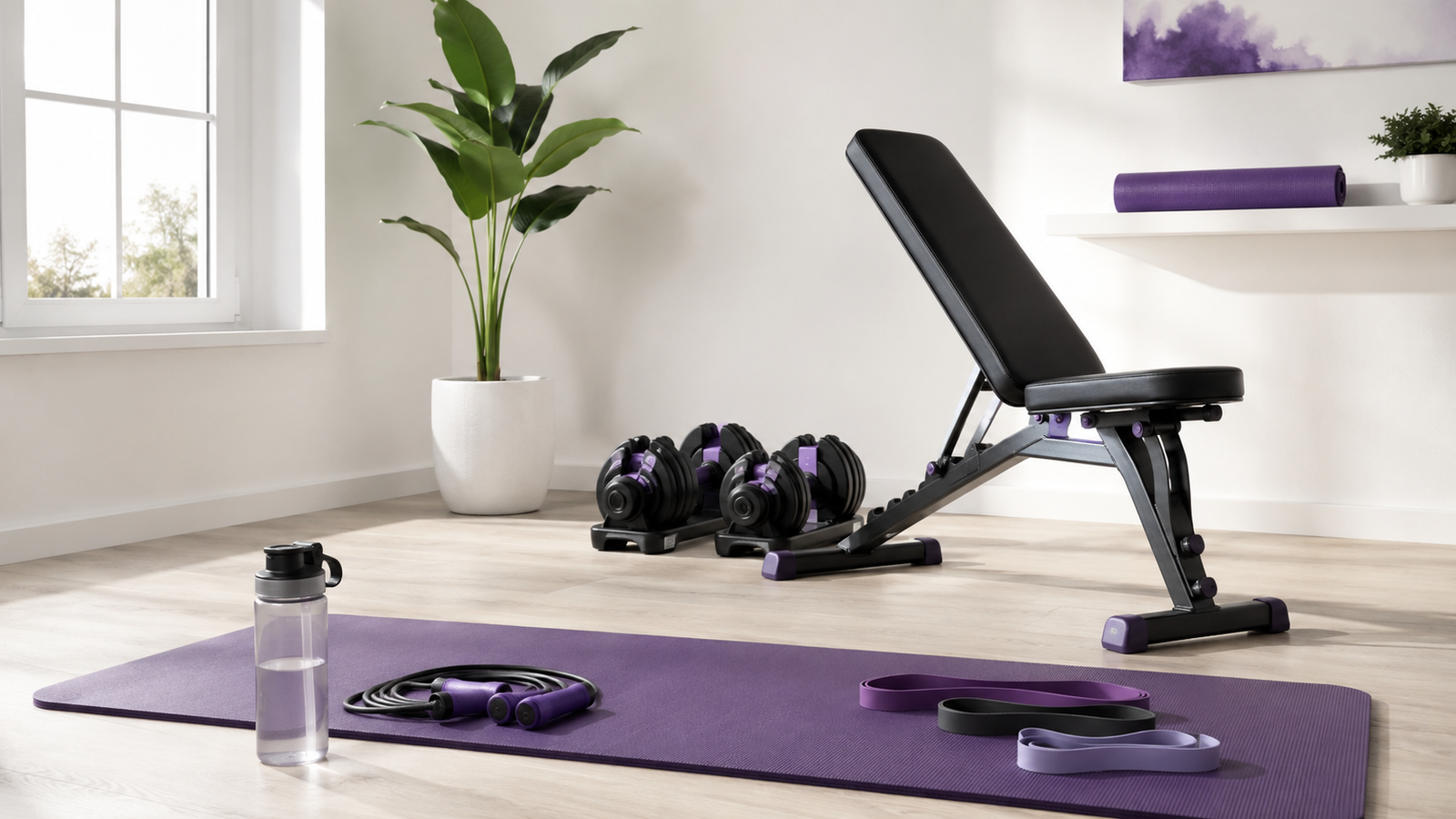
Building a home gym can make regular training more convenient. You remove travel time, avoid waiting for equipment, and can exercise around your own schedule. The challenge is not finding products. It is deciding which products genuinely support your goals.
For most beginners, the best approach is to buy a small number of versatile items and follow a structured program. The latest American College of Sports Medicine guidance emphasizes that consistent resistance training matters more for the average healthy adult than choosing one specific type of equipment. Bands, bodyweight exercises, free weights, and home-based routines can all be effective when the program is appropriate and sustainable.
How Much Home Gym Equipment Does a Beginner Need?
A beginner does not need a full rack, cable station, treadmill, and several specialty machines. A compact home gym equipment setup can train the major movement patterns: squat, hinge, push, pull, carry, and core stability.
Adults are generally advised to include muscle-strengthening activity on at least two days each week, working the major muscle groups. That can be achieved with handheld weights, resistance bands, or bodyweight exercises. Your first setup should therefore help you train the whole body rather than isolate only one muscle.
Before choosing home gym equipment, start by defining three limits:
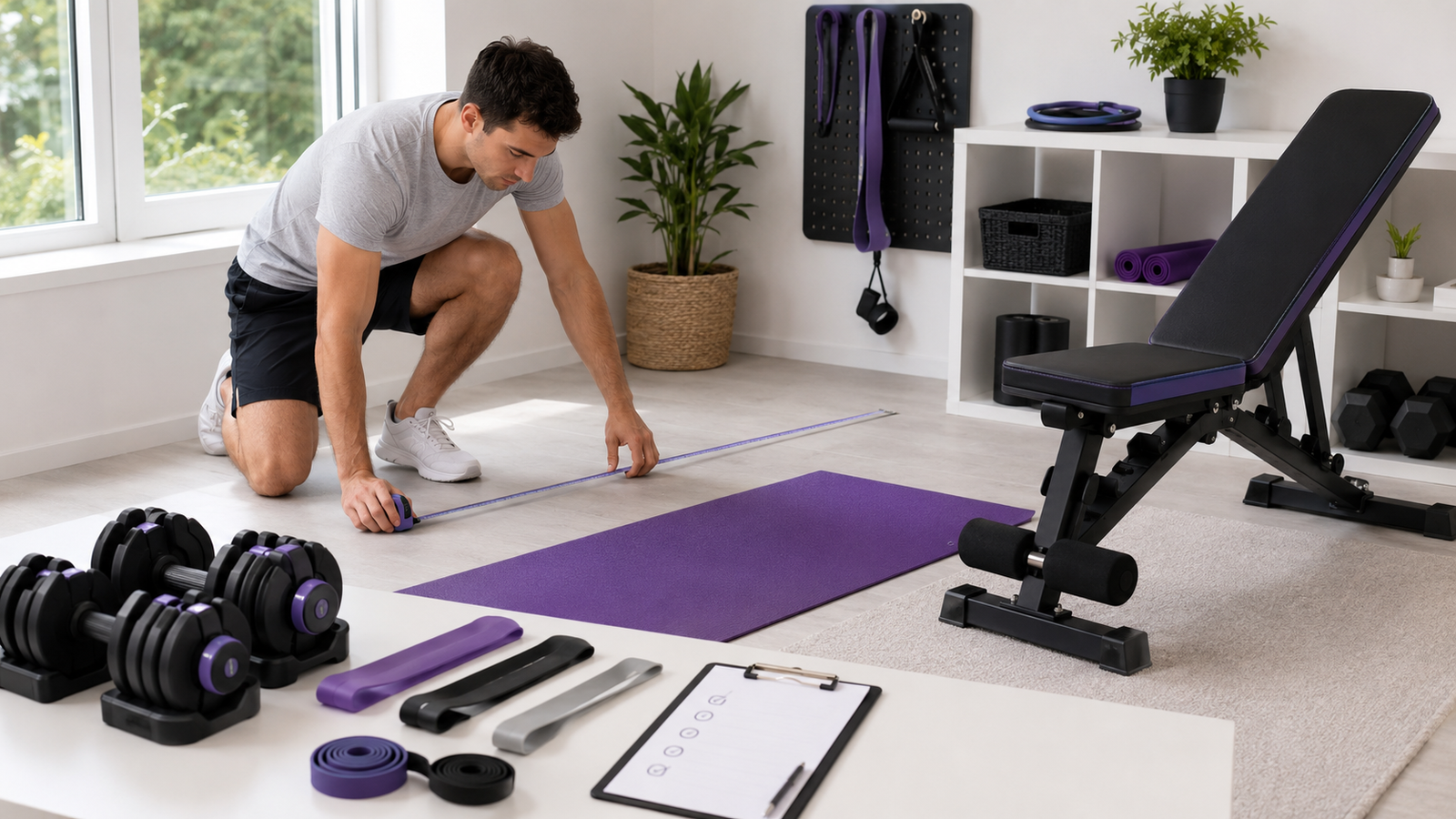
- Available space: measure the training area and storage area separately.
- Realistic budget: leave room for a useful program or coaching instead of spending everything on products.
- Current ability: choose resistance you can control with stable technique.
The 7 Best Home Gym Equipment Essentials for Beginners
1. Adjustable Dumbbells
Adjustable dumbbells are one of the most space-efficient home gym equipment choices for a beginner. A single pair can support goblet squats, Romanian deadlifts, floor presses, overhead presses, rows, lunges, curls, and loaded carries.
The main advantage is progression. As an exercise becomes easier, you can increase resistance in small steps instead of buying a completely new pair. Check how quickly the weight changes, whether the handle feels secure, and whether the selected range is suitable for both upper- and lower-body training.
Traditional fixed dumbbells may still be a better option when you have more space, prefer a simple solid design, or regularly change between weights. Read our internal comparison of adjustable dumbbells vs fixed dumbbells before deciding.
2. Resistance Bands
Resistance bands are inexpensive, light, and easy to store. Long loop bands can assist or resist compound exercises, while smaller loop bands are useful for warm-ups and lower-body movements. Bands can also create pulling exercises when anchored safely.
Look for clearly marked resistance levels and inspect each band regularly for cracks, thinning, or damage. Anchors must be stable, and the band should not be stretched toward the face. A complete resistance bands workout plan at home can help you use them as training tools rather than random accessories.
3. A Supportive Exercise Mat
An exercise mat creates a cleaner and more comfortable surface for floor presses, dead bugs, planks, mobility drills, stretching, and warm-ups. It does not need to be extremely thick. A mat that is too soft may make standing exercises less stable.
Choose enough length for your body, a non-slip surface, and a material that can be cleaned easily. If the floor is already cushioned, a thinner mat may be sufficient. For hard floors, slightly more padding can improve comfort during kneeling exercises.
4. A Stable Adjustable Bench
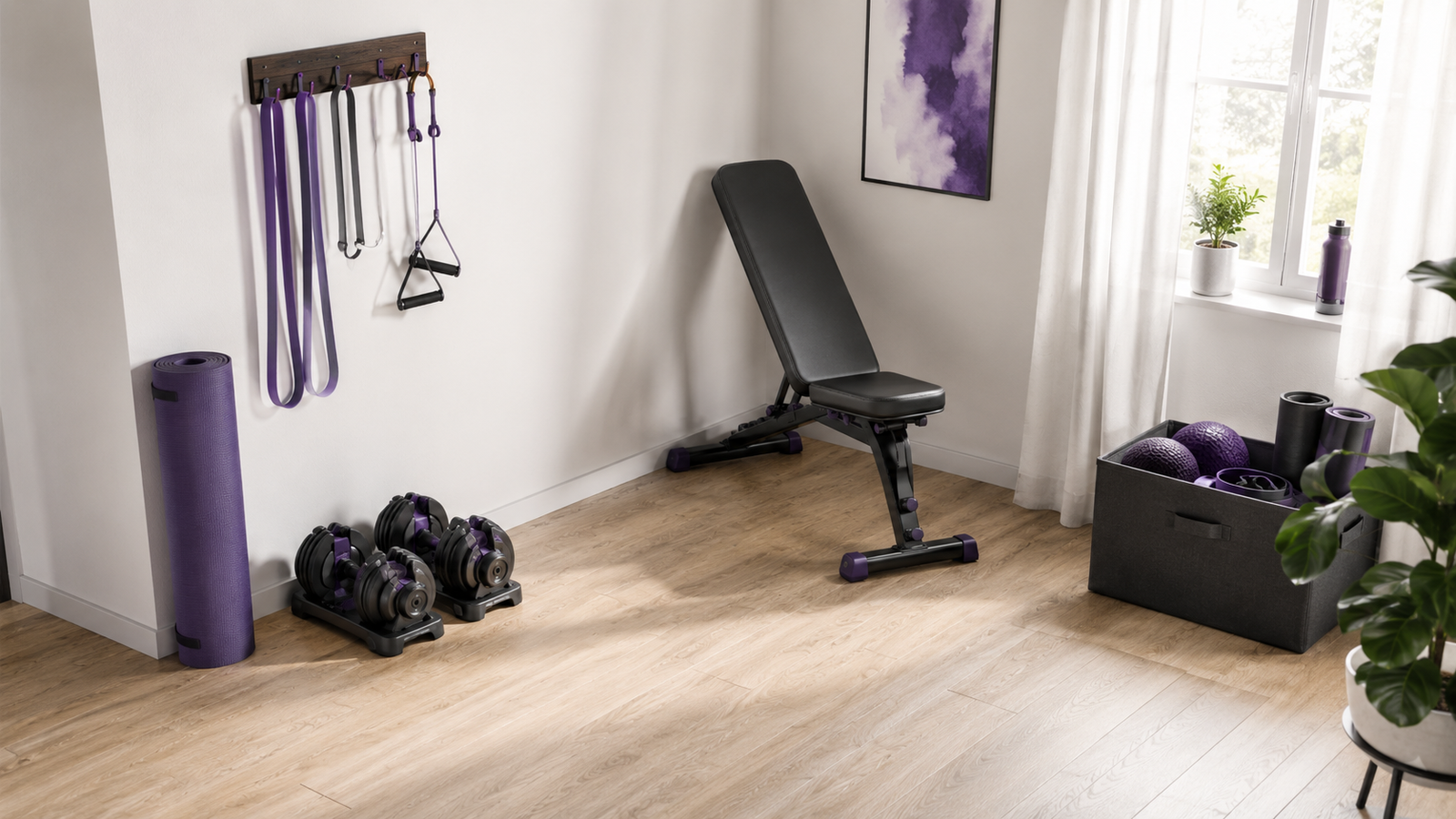
A bench expands your exercise options, but it is not always the first purchase. You can perform floor presses, split squats, rows, and many bodyweight movements without one. Add a bench when your program regularly includes supported rows, incline presses, seated presses, step-ups, or hip thrust variations.
Stability matters more than appearance. Check the maximum load rating, foot contact, hinge security, adjustment mechanism, and whether the bench rocks on your floor. A foldable model can save space, but it still needs to feel solid in every position you intend to use.
5. A Doorway Pull-Up Bar or Safe Suspension Option
Many basic home setups include several pushing exercises but few pulling movements. A suitable pull-up bar can support hangs, assisted pull-ups, and controlled pull-up progressions. Some models can also anchor bands, but only when the manufacturer explicitly allows it.
Confirm that the doorway, wall, or mounting surface is compatible with the product. Follow installation instructions exactly, test the setup gradually, and avoid improvised attachments. Beginners who cannot perform a pull-up can use band-assisted variations or dumbbell rows instead.
6. A Jump Rope or Simple Cardio Option
Cardio equipment does not have to mean a large treadmill or bike. A jump rope can provide short, vigorous conditioning sessions in a small space when your joints, ceiling height, and floor allow it. Walking, stair climbing, cycling outdoors, or low-impact bodyweight circuits are also valid options.
The CDC recommends that adults work toward at least 150 minutes of moderate-intensity aerobic activity per week, or an equivalent amount of vigorous activity, in addition to muscle-strengthening work. You can meet that target without buying a cardio machine.
7. Small Accessories That Improve Training Quality
A few low-cost home gym equipment accessories can make training more organized. A timer helps manage rest periods. A notebook or tracking app records sets, repetitions, and resistance. Collars improve plate security when using loadable dumbbells. A small storage rack or box keeps the floor clear.
These items are useful only when they solve a real problem. Avoid collecting specialty handles, balance gadgets, or recovery tools before you consistently use the core home gym equipment.
How to Choose Home Gym Equipment Wisely
Prioritize Versatility
Versatile home gym equipment supports several exercises and remains useful as you become stronger. Dumbbells and bands usually offer more long-term value than a single-purpose device. Before buying, write down at least five exercises the item will support in your weekly plan.
Check Safety and Build Quality
Read the manufacturer’s load limits and installation instructions. Check handles, welds, adjustment pins, locking systems, anchors, and non-slip feet. Reviews can reveal common problems, but your final decision should be based on specifications, warranty, return policy, and suitability for your space.
Choose a Useful Resistance Range
Lower-body exercises generally use more load than smaller upper-body movements. A very light set may work for lateral raises but quickly become limiting for squats or deadlifts. At the same time, a heavy starting weight is not useful when you cannot control it.
Progressive overload can involve more than adding weight. You may add repetitions, improve range of motion, slow the lowering phase, perform an extra set, or choose a more challenging variation. This allows basic equipment to remain useful longer.
Plan Storage Before Delivery
Home gym equipment left in walkways creates clutter and may become a safety problem. Decide where every item will be stored before purchasing it. Measure doors, corners, and vertical clearance. Foldable designs are helpful only when you can fold and move them comfortably.
Beginner Home Gym Setup by Budget
| Setup level | Suggested equipment | Best for |
|---|---|---|
| Minimal | Exercise mat, one or two resistance bands, bodyweight plan | Small spaces and testing a new routine |
| Core beginner | Adjustable dumbbells, bands, mat, timer or training log | Full-body strength training with progression |
| Expanded | Core setup plus stable bench and suitable pulling option | More exercise variety and longer-term training |
Prices vary widely by location and product quality, so a fixed budget can be misleading. Instead, buy in stages. Begin with the item that unlocks the largest part of your program, train consistently for several weeks, and then identify the clearest limitation.
5 Common Home Gym Equipment Buying Mistakes
1. Buying Before Choosing a Program
Without a program, it is easy to buy equipment that does not work together. Choose the training structure first, then build the setup around it.
2. Choosing the Cheapest Option Automatically
Low prices are attractive, but unstable benches, weak locking mechanisms, and poorly made bands can cost more when they need early replacement. Look for value, not simply the lowest price.
3. Ignoring Noise and Flooring
Dropping weights can damage floors and disturb neighbors. Use controlled repetitions, suitable flooring, and equipment that fits your living environment. A home workout should not create unnecessary risk or conflict.
4. Buying for an Imaginary Future Routine
Large machines often look motivating in the showroom. They become expensive storage when they do not match your schedule or preferred exercises. Buy for the routine you are prepared to perform now.
5. Expecting Equipment to Replace Consistency
The most advanced home gym equipment cannot compensate for an unclear plan, irregular training, poor recovery, or unrealistic expectations. Structure and adherence drive progress.
Simple Full-Body Workout With Basic Equipment
This example shows how a small setup can cover the whole body. It is educational and should be adjusted to your ability, health status, and available equipment.
- Goblet squat: 2–3 sets of 8–12 controlled repetitions.
- Dumbbell Romanian deadlift: 2–3 sets of 8–12 repetitions.
- Floor press or elevated push-up: 2–3 sets of 8–12 repetitions.
- One-arm dumbbell row or band row: 2–3 sets per side.
- Split squat: 2 sets per side.
- Dead bug or plank: 2–3 controlled sets.
Use a resistance that allows stable technique while making the final repetitions challenging. The CDC describes 8–12 repetitions as one practical range for muscle-strengthening work and notes that adults can begin with at least one set before building toward more volume.
Need a plan matched to your schedule and current level? Review our guide on how to choose an online fitness coach before selecting support.
Final Home Gym Equipment Checklist
- Does each item support exercises in your current program?
- Is the product stable, durable, and suitable for your body and floor?
- Can you progress the exercise over time?
- Do you have enough clear training and storage space?
- Have you checked load limits, warranty, returns, and installation requirements?
Start with dumbbells or bands, a mat, and a clear full-body program. Add a bench or other equipment only when it solves a specific training limitation. A simple setup used consistently is more valuable than a crowded room of unused products.
Frequently Asked Questions
What home gym equipment should a beginner buy first?
Most beginners can start with adjustable dumbbells or a suitable fixed pair, resistance bands, an exercise mat, and enough open floor space. Add a bench only when the workout plan requires one.
Can you build muscle with basic home gym equipment?
Yes. Muscle growth depends on consistent resistance training, progressive overload, nutrition, and recovery. Basic equipment can provide effective resistance when used in a structured plan.
How much space does a beginner home gym need?
A beginner can train in a small area large enough to lie down, extend the arms, and move safely. Adjustable or foldable equipment can reduce storage requirements.
Do beginners need a treadmill or large exercise machine?
No. Walking outdoors, bodyweight exercises, dumbbells, and resistance bands can cover many beginner goals. Buy a large machine only when it fits your space, budget, preferences, and training plan.
Build a Home Workout Plan You Can Follow
MedFitCoach helps you turn basic equipment into a structured plan built around your level, schedule, available space, and goals.
View MedFitCoach PackagesMedical note: This article is for general education and is not medical advice. Speak with a qualified healthcare professional before starting or changing exercise if you have a medical condition, injury, disability, pregnancy, symptoms, or concerns about vigorous activity.